MariaDB vs PostgreSQL An In-Depth Database Comparison
Explore a detailed MariaDB vs PostgreSQL comparison covering architecture, performance, SQL features, and real-world use cases to choose the right database.
By Rishav
6th Feb 2026
Last updated: 6th Feb 2026
The choice between MariaDB and PostgreSQL often boils down to a fundamental trade-off. If you need raw speed for high-throughput transactional work, MariaDB is a fantastic choice. But for complex applications where data integrity, advanced analytics, and strict standards compliance are critical, PostgreSQL is the clear winner.
Ultimately, your decision hinges on what you value more: operational simplicity and blistering performance, or a robust, feature-dense system built for complex data handling.
Making the Right Choice: MariaDB vs. PostgreSQL
When you’re weighing MariaDB against PostgreSQL, you're looking at two top-tier, open-source relational databases that come from very different schools of thought. MariaDB, a community-driven fork of MySQL, carries on its predecessor's legacy of speed and ease of use. This makes it a go-to for web applications and e-commerce platforms where rapid read/write operations are the name of the game.
On the other hand, PostgreSQL is an object-relational database celebrated for its strict SQL standards, powerful extensibility, and unwavering focus on data integrity. It has carved out a strong niche in data warehousing, complex financial systems, and scientific applications—anywhere accuracy and advanced querying are paramount.
Community Standing and Developer Preference
Developer sentiment can be a powerful indicator of a technology's health and future. In the world of open-source databases, PostgreSQL has clearly captured the hearts and minds of the community. In recent developer surveys, PostgreSQL was named the most admired database at 65% and the most desired at 46%, leaving many rivals behind. You can find more details on this developer preference trend here.
This isn't to say MariaDB isn't a solid, reliable choice. It is. But the data highlights a clear preference: developers building scalable, feature-rich applications are increasingly turning to PostgreSQL for its robust capabilities and reputation for stability.
To cut through the noise, we've put together a quick decision matrix. This table is designed to give you an at-a-glance comparison, helping you align the strengths of each database with your specific project needs.
MariaDB vs PostgreSQL High-Level Decision Matrix
The table below offers a quick summary to guide your choice based on common project priorities. Think of it as a cheat sheet for making a fast, informed decision.
| Use Case / Priority | Choose MariaDB If... | Choose PostgreSQL If... |
|---|---|---|
| Primary Workload | You need high-throughput Online Transaction Processing (OLTP) for systems like e-commerce or a CMS. | Your application involves complex queries, data analysis (OLAP), or geospatial data. |
| High Availability | You prefer a native, multi-master clustering solution like the integrated Galera Cluster. | You require flexible replication and can manage powerful external clustering tools like Patroni. |
| SQL Compliance | You are migrating from MySQL and need maximum compatibility with its SQL dialect. | You need strict SQL standards compliance and access to advanced functions like windowing and CTEs. |
| Flexibility | You want the ability to swap out storage engines (e.g., InnoDB, ColumnStore) to fit the workload. | You prefer a single, powerful, and highly extensible core architecture that excels at its job. |
Choosing the right database from the start can save you countless hours down the line. Whether you're a startup founder prioritizing speed to market or a data analyst who needs serious query power, this framework should point you in the right direction.
Contrasting Core Architectural Philosophies
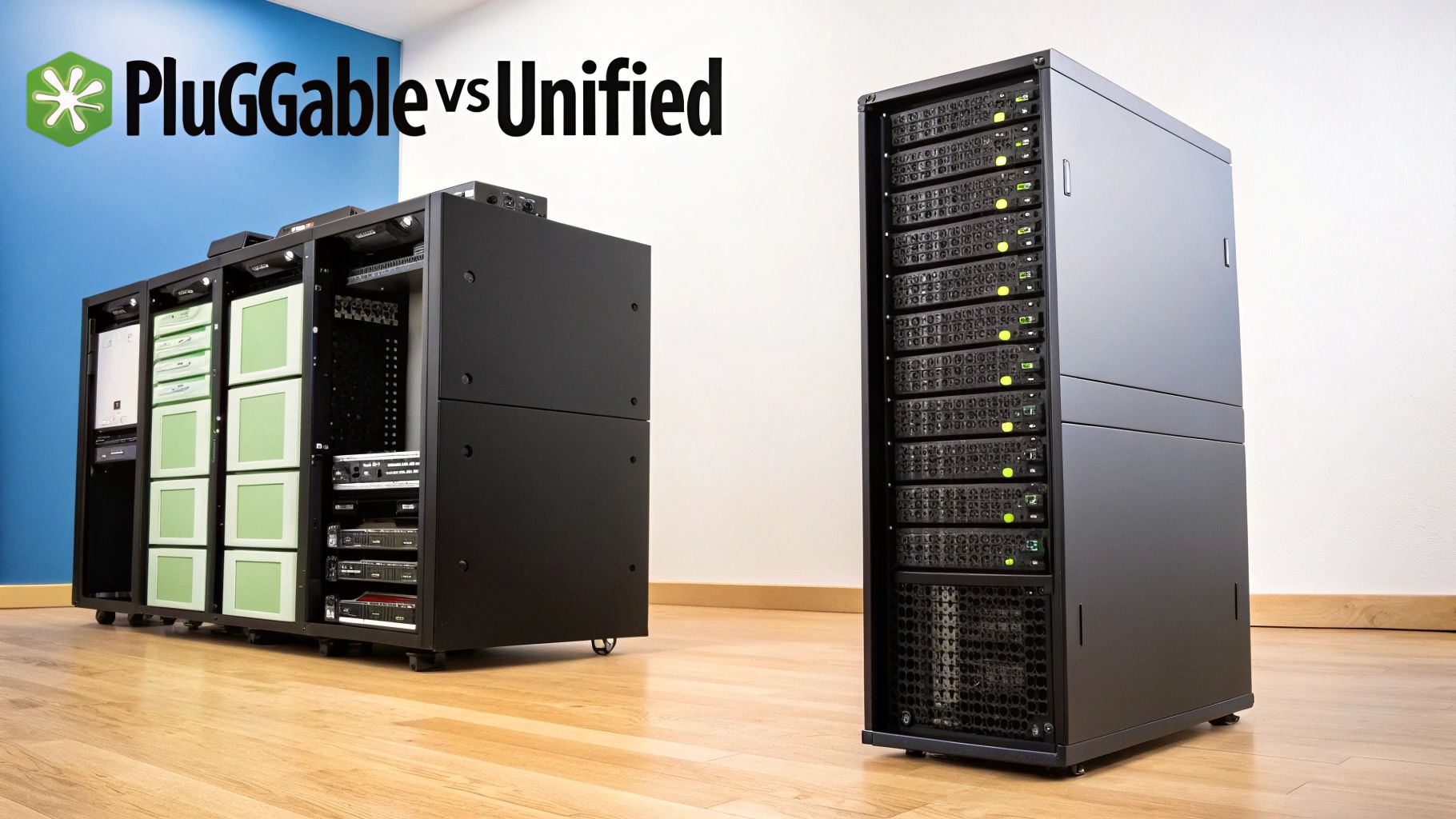
Before you even write a single query, MariaDB and PostgreSQL have already made fundamental design choices that will shape your entire experience. These core philosophies are really the heart of the MariaDB vs PostgreSQL debate, defining how they store data, manage resources, and behave under pressure. Getting this right is crucial for your application's long-term health.
MariaDB’s design is all about flexibility. It’s built around a pluggable storage engine architecture, which basically means you can choose the right tool for the job. You aren't stuck with a one-size-fits-all solution.
PostgreSQL takes the opposite approach. It has a single, unified architecture—a powerful, meticulously engineered storage engine that handles everything. This design puts data consistency, strict standards compliance, and robust features first, ensuring every table gets the same bulletproof level of data integrity.
MariaDB: The Power of Choice in Storage Engines
Being able to swap storage engines is MariaDB's standout feature. Think of it as having a workshop full of specialized tools instead of a single multi-tool. This approach lets you fine-tune performance for a specific job.
Here are the most common engines you'll encounter:
- InnoDB: This is the default and your go-to for most online transaction processing (OLTP) work. It delivers full ACID compliance, row-level locking, and foreign keys.
- Aria: A more modern, crash-safe version of the old MyISAM engine. It’s often used for internal temporary tables where you need speed and can live without full transactional guarantees.
- ColumnStore: Built for analytics. This engine stores data in columns instead of rows, which makes it incredibly fast for running big aggregation queries in a data warehouse.
- MyRocks: Optimized for write-heavy workloads that need high compression. It's a great fit for logging systems or IoT applications that ingest massive amounts of data.
This architectural flexibility means a single MariaDB server can simultaneously host tables for high-speed transactions (InnoDB) and complex analytics (ColumnStore), managed under one roof. This versatility is a major draw for teams that need to support varied workloads without deploying multiple database systems.
PostgreSQL: The Unified and Extensible Core
PostgreSQL's philosophy is to provide one exceptionally reliable engine that does everything well. Instead of offering different engines, it gives you an incredibly rich system of extensions to add specialized functionality. This means core behaviors like transactions, concurrency, and durability are dead consistent across the entire database.
This unified approach guarantees that no matter what you're storing, it's protected by the same rigorous ACID compliance and integrity rules. The system is built to be predictable and dependable—a non-negotiable feature for enterprise apps where data correctness is paramount. While you can't swap the core engine, you can bolt on powerful extensions like PostGIS for geospatial data or TimescaleDB for time-series analysis, effectively turning it into a specialist tool without compromising its solid foundation.
How MVCC Implementation Differs
Both databases use Multi-Version Concurrency Control (MVCC) to let reads and writes happen at the same time without readers getting blocked. But how they do it speaks volumes about their core design.
PostgreSQL's MVCC creates a new version of a row when it's updated, marking the old one as "dead." These old versions hang around until a process called VACUUM comes along to clean them up. If you don't tune this process carefully, you can end up with table bloat and performance degradation, which means you need to stay on top of maintenance.
MariaDB's InnoDB engine takes a more automated approach, using background purge threads to continuously clean up old row versions. This design often leads to more predictable long-term performance with less manual intervention, making life a bit easier for the operations team. This small difference is a perfect example of PostgreSQL prioritizing transactional correctness, while MariaDB leans toward operational simplicity.
Comparing Advanced SQL And Data Type Capabilities
This is where the rubber really meets the road. A database's true power isn't just in storing data, but in how it lets you work with it—especially when dealing with complex data models and advanced queries. Both MariaDB and PostgreSQL are fully SQL-compliant, of course, but their philosophies and capabilities start to diverge sharply when you push past basic CRUD operations.
This is a critical battleground in the MariaDB vs PostgreSQL debate. The right features can make development faster and more elegant, while the wrong ones can force you to solve complex problems in your application code instead of in the database where they often belong.
PostgreSQL has built its reputation on a rich, standards-compliant feature set, often adopting new SQL capabilities years ahead of the curve. This gives developers a massive head start. MariaDB, on the other hand, often focuses on performance and maintaining that close compatibility with MySQL, which means its SQL feature set, while constantly improving, sometimes lags behind.
Handling Semi-Structured Data With JSON
How a database handles JSON is a perfect example of their different approaches. For modern applications with flexible schemas, this can be a make-or-break feature.
MariaDB offers a JSON data type, but there's a catch: it's an alias for LONGTEXT. It comes with a set of functions to ensure the text is valid JSON, but at its core, it's still just a string. Every time you need to dig into that JSON document, the database has to parse the text on the fly. It works, but it's not fast.
PostgreSQL, in contrast, provides two native options: JSON and JSONB. The JSON type is a simple text storage, much like MariaDB's implementation. The real magic is JSONB, which stores the data in a decomposed binary format. This is an absolute game-changer.
- Lightning-Fast Queries: Because
JSONBis a binary format, it can be indexed. This allows for incredibly fast lookups of keys and values inside a document without that costly text-parsing overhead. - Powerful Indexing: You can use PostgreSQL’s Generalized Inverted Index (GIN) on
JSONBcolumns, making it trivial to efficiently search for specific keys or values across millions of records. - Processing Efficiency: The binary format is often more compact and is optimized for the database engine to process, boosting performance for read-heavy workloads.
For any application that leans heavily on semi-structured data—think product catalogs with unique attributes, event logging systems, or flexible content management—PostgreSQL's
JSONBoffers a massive advantage. This isn't just a theoretical win; it translates directly to faster APIs and a snappier user experience.
Window Functions And Common Table Expressions
When you get into serious data analysis, PostgreSQL’s native SQL features really shine. Two of the most powerful tools in its arsenal are window functions and Common Table Expressions (CTEs).
Window functions are a lifesaver for analytical queries. They let you perform calculations across a set of rows related to the current row, which is perfect for running totals, ranking products within categories, or calculating moving averages without resorting to messy self-joins.
Common Table Expressions (CTEs), kicked off with the WITH clause, let you create temporary, named result sets. They break down monstrous queries into logical, readable steps. PostgreSQL has long supported both standard and recursive CTEs, which are essential for navigating hierarchical data like an org chart or a threaded comment system.
MariaDB has made huge progress here, adding support for window functions and CTEs. However, PostgreSQL’s implementations are more mature and battle-tested. For anyone working in analytics or business intelligence, this means you can write cleaner, faster, and more powerful queries right inside Postgres.
Feature And Functionality Deep Dive
Let's put these differences side-by-side to get a clearer picture of where each database stands. This table breaks down some of the most critical capabilities for developers and data analysts.
| Feature/Capability | MariaDB | PostgreSQL | Key Takeaway |
|---|---|---|---|
| JSON Support | JSON type is an alias for LONGTEXT with validation functions. Queries require parsing text. | Native JSON and binary JSONB types. JSONB is indexed for high-performance querying. | PostgreSQL is far superior for applications that heavily query semi-structured data. |
| Window Functions | Supported since version 10.2. Allows for analytical functions like RANK() and ROW_NUMBER(). | Full, mature support for a wide range of window functions. | Both have support, but PostgreSQL's implementation is more established and feature-complete. |
| CTEs | Supports non-recursive CTEs. Recursive CTEs were added in version 10.2. | Robust support for both non-recursive and recursive CTEs, ideal for hierarchical data. | PostgreSQL has a long-standing and powerful implementation for complex query logic. |
| Data Types | Rich set of standard types. Good support for spatial data with GEOMETRY. | Extensive collection of native types including network addresses (INET), arrays, ranges, and UUIDs. | PostgreSQL's diverse native data types can simplify application logic by handling data validation at the database level. |
In the end, your choice in the MariaDB vs PostgreSQL showdown comes down to your application's complexity. If your primary need is for a fast, reliable transactional database with straightforward queries, MariaDB is an excellent choice. But if you're building an application that requires sophisticated data analysis, flexible data models, or complex business logic built into the database layer, PostgreSQL's advanced SQL toolkit gives you a much stronger foundation to build on.
A Look at Performance and Scalability
Performance isn't a simple number on a chart; it's all about the workload. When you get past the canned benchmarks, the real story in the MariaDB vs PostgreSQL debate is how each database handles your specific needs. Are you juggling thousands of tiny transactions every second, or are you running deep, complex analytical queries?
Their core designs set them on different paths. MariaDB, with its multi-threaded model and the battle-tested InnoDB engine, is engineered for high-concurrency speed. On the other hand, PostgreSQL’s process-per-connection architecture and its famously sophisticated query planner give it a serious advantage when the queries get complicated and the datasets get huge.
MariaDB: The High-Throughput OLTP Specialist
MariaDB really shines in Online Transaction Processing (OLTP). We're talking about the backends for e-commerce stores, busy websites, or SaaS platforms that need to handle a constant storm of small, fast read-and-write operations from many users at once.
Its multi-threaded architecture is the star of the show here. It can juggle thousands of simultaneous connections without the heavy memory footprint you’d see from a multi-process model. This makes it incredibly responsive to the bursty, high-concurrency traffic typical of web applications.
On top of that, the default InnoDB storage engine comes packed with features perfect for OLTP:
- Row-level locking keeps things moving smoothly, preventing users from stepping on each other's toes when they update different records in the same table.
- An intelligent buffer pool caches your hot data in memory, dramatically cutting down on slow disk access.
- Continuous background purge threads handle cleanup automatically, maintaining stable performance without the need for the kind of intensive vacuuming maintenance some other databases require.
PostgreSQL: The Powerhouse for Complex Analytics
If MariaDB is a sprinter, PostgreSQL is a marathoner built for tough, analytical terrain. Its real power emerges in Online Analytical Processing (OLAP) workloads, where you're running intricate queries across massive datasets. Think data warehousing, business intelligence reporting, and scientific computing.
PostgreSQL's query optimizer is legendary in the open-source world for a reason. It can brilliantly dissect a monster query with multiple joins, subqueries, and aggregations to find the most efficient way to execute it. That’s a game-changer for analytical jobs that would otherwise bring a simpler database to its knees.
Imagine a financial firm running quarterly reports that pull together customer, transaction, and market data. PostgreSQL's knack for optimizing that kind of massive, multi-table query is a lifesaver. It does the heavy lifting, turning what could be an hour-long ordeal into a report that runs in just minutes.
Its rich feature set, including powerful window functions, Common Table Expressions (CTEs), and a vast library of data types, lets analysts do their heavy lifting right inside the database. This is far more efficient than shuffling huge amounts of data back to an application for processing.
Scaling Up: Two Different Philosophies
As your application grows, your database needs to keep up. MariaDB and PostgreSQL both offer powerful scaling strategies, but they approach the problem from different angles.
MariaDB's Built-in Clustering For high availability and horizontal scaling, MariaDB’s trump card is Galera Cluster. It's a native, multi-master replication solution that’s baked right into the database.
- Synchronous Replication: Every node in the cluster has the exact same data at the same time. This gives you a true multi-master setup where you can write to any node—a huge simplification for load balancing.
- Automatic Node Provisioning: Adding a new server to the cluster is a straightforward, largely automated affair.
- No Single Point of Failure: If a node goes down, the cluster carries on without interruption, giving you excellent uptime.
This integrated approach makes spinning up a resilient, highly available cluster a relatively low-friction process for your operations team.
PostgreSQL's Flexible Replication Ecosystem PostgreSQL takes a more modular, component-based route to scaling. It provides robust, built-in replication features that act as a foundation for a rich ecosystem of specialized, third-party tools.
- Streaming Replication: This is the standard for creating read replicas, which is essential for offloading read-heavy traffic from your primary database.
- Logical Replication: A more advanced feature that lets you replicate changes based on their logical structure, not just their physical location on disk. This opens up possibilities like replicating between different major PostgreSQL versions or even to other database systems.
- External Tooling: For bulletproof automatic failover and cluster management, the community overwhelmingly turns to battle-hardened tools like Patroni. It manages a high-availability PostgreSQL cluster using a distributed configuration store like etcd or Consul.
This model provides incredible flexibility to engineer the precise scaling architecture your application demands. However, it often means integrating and managing a few more moving parts compared to MariaDB's all-in-one Galera solution. The right choice really comes down to whether you prefer a tightly integrated system or a more customizable, best-of-breed approach.
Choosing the Right Database for Your Role
So, which one is it? MariaDB or PostgreSQL? The truth is, the "best" database really depends on who's asking. The right choice hinges on your team's expertise, the project's real-world needs, and what your organization values most. What looks like a perfect fit for a fast-moving startup could become a major headache for an operations manager focused on stability.
To cut through the noise, let's look at this decision from the perspective of different roles. This isn't about picking an overall winner. It's about matching the right tool to the right job so your database becomes a strategic asset, not just another piece of infrastructure to manage.
Recommendations for Startup Founders and Product Managers
If you're a founder or a product manager, your world revolves around speed. Getting an MVP out the door and iterating quickly is everything. Your tech stack needs to be an accelerator, not an anchor.
This is where MariaDB often shines. Its MySQL roots mean you have access to a massive talent pool and a mature ecosystem of tools, frameworks, and hosts. That translates directly into faster development and easier hiring. MariaDB's well-earned reputation for blistering performance on standard web workloads also ensures your app feels responsive from the get-go.
But hold on. If your product roadmap hints at complex analytics, geospatial data, or sophisticated data modeling, PostgreSQL is the more strategic play. Its rich feature set can save you from a painful and expensive migration later on as your product inevitably grows more complex.
This flowchart boils down that core trade-off.
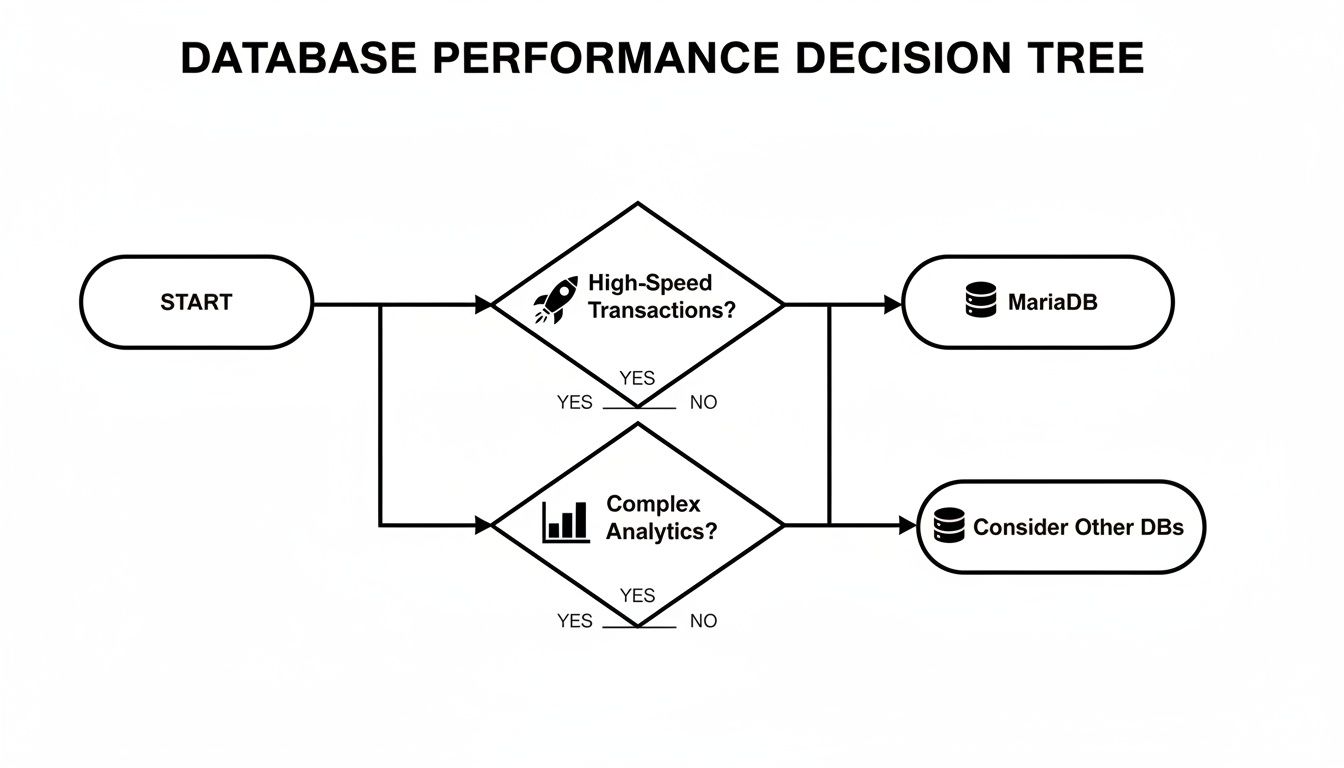
The takeaway is clear: if you’re building something that needs to handle a high volume of straightforward transactions, MariaDB is likely your best bet. If your application's value comes from deep data analysis and reporting, PostgreSQL is the way to go.
Guidance for Operations Managers and Developers
Devs and ops folks are the ones who have to live with the database choice day in and day out. Their priorities are stability, predictable performance, and tools that make their lives easier.
From an operations standpoint, MariaDB’s integrated Galera Cluster is a big win. It provides a straightforward, out-of-the-box solution for high availability with its multi-master setup. PostgreSQL’s replication is rock-solid, but setting up true automated failover often means bringing in external tools like Patroni, which adds another moving part to manage.
For developers, the decision gets a bit more personal.
- Go with MariaDB if: Your team already has deep MySQL experience, and you're building a classic high-throughput OLTP application using standard SQL.
- Lean towards PostgreSQL if: You can simplify your application logic by offloading work to the database. Its advanced data types (like arrays or network addresses), powerful window functions, and fantastic
JSONBsupport are game-changers for handling complex or semi-structured data.
For Finance Leads and Data Analysts
When money is on the line, data integrity is everything. There is zero room for error. This is why financial applications and serious data analysis workloads almost always run on PostgreSQL.
Its rigorous adherence to ACID compliance guarantees that every transaction is handled with absolute reliability. Beyond that, its sophisticated query optimizer and deep bench of analytical functions are tailor-made for complex financial reporting. Features like Common Table Expressions (CTEs) and window functions let analysts build intricate calculations right inside the database, which is crucial for maintaining data consistency and accuracy.
While MariaDB is certainly capable, PostgreSQL’s reputation for data integrity and its powerful analytical toolkit make it the undisputed gold standard where precision matters most.
Still on the Fence? Answering Your Lingering MariaDB vs. PostgreSQL Questions
Even with a side-by-side comparison, a few practical questions always pop up when you're making the final call. Let's tackle some of the most common ones to clear up any final uncertainties.
These are the real-world concerns we hear most often—from migration headaches to which one handles specific jobs better.
Is MariaDB a Drop-In Replacement for MySQL?
For the most part, yes. MariaDB was built from the ground up to be a binary drop-in replacement for its equivalent MySQL version. This is its biggest claim to fame, allowing teams to swap out MySQL for MariaDB with virtually no code changes.
But that compatibility ends there. Don't make the mistake of thinking you can do the same with PostgreSQL. Moving from MariaDB to PostgreSQL (or vice-versa) is a serious project. You'll need to convert schemas, migrate data carefully, and rewrite parts of your application to handle differences in SQL dialects, data types, and built-in functions.
Which Database Is Better for Large-Scale Analytics?
When your queries get complex—think multiple joins, nested subqueries, and heavy aggregations—PostgreSQL usually pulls ahead. Its query planner is one of the most sophisticated out there, and its native support for features like window functions and Common Table Expressions (CTEs) is purpose-built for slicing and dicing large datasets.
MariaDB does have a dedicated ColumnStore engine for analytics, which can be incredibly fast for certain workloads. However, PostgreSQL's core engine is more consistently powerful across a broader range of analytical tasks right out of the box, making it a more dependable choice for a general-purpose data warehouse.
How Do Their Ecosystems and Communities Compare?
Both databases are backed by passionate, active open-source communities, but they have distinct personalities.
The PostgreSQL community is famously meticulous. Their focus on strict adherence to SQL standards and a rigorous development process is why PostgreSQL has such a strong reputation for stability and rock-solid data integrity. This has also led to an incredible ecosystem of powerful extensions, like PostGIS for geospatial data.
The MariaDB community, which originated from the MySQL fork, is driven by a commitment to performance, open governance, and that all-important MySQL compatibility. It taps into the massive existing talent pool and tooling built for MySQL over the decades, giving it a huge head start in terms of available documentation, third-party tools, and developer expertise.
Ready to stop wrestling with database configurations and start building? With FlyDash, you can generate a complete application—frontend, backend, and database—in minutes just by describing your needs. Connect your data, collaborate in real-time, and deploy anywhere. Build your next internal tool faster at https://flydash.io.
Ready to Build Your App?
Turn your idea into a production-ready React Native app in minutes.
Free tools to get you started
Free AI PRD Generator
Generate a professional product requirements document in seconds. Describe your product idea and get a complete, structured PRD instantly.
Try it freeFree AI App Name Generator
Generate unique, brandable app name ideas with AI. Get creative name suggestions with taglines, brand colors, and monogram previews.
Try it freeFree AI App Icon Generator
Generate beautiful, professional app icons with AI. Describe your app and get multiple icon variations in different styles, ready for App Store and Google Play.
Try it freeFrequently Asked Questions
RapidNative is an AI-powered mobile app builder. Describe the app you want in plain English and RapidNative generates real, production-ready React Native screens you can preview, edit, and publish to the App Store or Google Play.