Low Code vs Traditional Development Which is Right For You
Discover the real differences in the low code vs traditional development debate. This guide covers speed, cost, and scalability to help you choose wisely.
By Damini
19th Jan 2026
Last updated: 19th Jan 2026

The whole low-code vs traditional development debate really comes down to one fundamental trade-off: speed versus control.
Low-code platforms let you build and ship applications incredibly fast using visual tools and pre-made components. This makes them perfect for things like rapid prototyping or building internal business tools. On the other hand, traditional development gives you complete, granular control over every aspect of your application, which is non-negotiable for complex, mission-critical software.
Framing the Development Decision
Picking between these two isn't about which one is "better" in a vacuum. It’s about choosing the right tool for the job at hand. Your decision should really be guided by a few key business realities: how fast you need to move, what resources you have available, and how much flexibility you need down the road.
One approach gets a working product into users' hands in days, while the other is built for the long haul, ensuring every single line of code is optimized for complex, large-scale systems. This guide will walk you through the practical trade-offs so you can make a smart call that balances today's needs with tomorrow's goals.
High-Level Comparison At a Glance
To kick things off, let's just lay out the core differences side-by-side. This table gives you a quick, at-a-glance view of how the two stack up across the most important criteria.
| Criterion | Low-Code Development | Traditional Development |
|---|---|---|
| Development Speed | Extremely fast; days or weeks | Slower; months or years |
| Required Skills | Business logic, process knowledge | Expert programming, architecture |
| Initial Cost | Lower initial development cost | Higher initial development cost |
| Customization | Limited by platform capabilities | Virtually unlimited |
| Scalability | Good, but can face platform limits | High; architected for scale |
| Maintenance | Managed by platform; simpler | Requires dedicated dev teams |
As you can see, the differences are pretty stark. And the market is clearly voting for speed.
Projections show that by 2026, a staggering 75% of new apps will be built using low-code. We're also seeing citizen developers—non-technical staff building apps—growing five times faster than IT departments can keep up.
This shift isn't just hype; it's delivering real results. One survey found that 71% of low-code users slashed their application development time from months down to days. That kind of acceleration is a game-changer for any business. For a deeper dive into these numbers, you can check out this detailed low-code trend analysis.
Low-Code vs. Traditional Development: A Head-to-Head Comparison
Choosing between low-code and traditional development isn't about picking the "best" one—it's about picking the right one for the job at hand. The best choice comes down to the specific pressures, resources, and goals of your project.
To get past the marketing hype, we need to dig into the practical realities of building and maintaining software. Let's break down the real differences across seven key areas.
1. Development Speed and Time to Market
This is where the difference is most stark. Low-code platforms are built for one thing above all else: speed. They use visual interfaces, drag-and-drop components, and ready-made integrations to let you assemble applications in a fraction of the time it would take to code them from scratch. This is their core promise.
Think about building a custom internal tool for tracking marketing campaign performance. A traditional development team might spend months scoping requirements, designing the database, coding the backend, building the UI, and finally deploying it. With a low-code platform, a sharp marketing manager could potentially build a working version of that same tool in just a week.
The numbers don't lie. Low-code can be a staggering 10x faster than traditional platforms, with studies showing an average of 56% quicker solution delivery overall. For some digital projects, that time savings can even hit 90%. For a deeper look at these figures, you can explore the latest low-code statistics and trends.
2. Cost and Resource Allocation
Cost is directly tied to speed and who you need to hire. Traditional development requires a heavy upfront investment in a team of highly skilled—and expensive—software engineers, DevOps specialists, and project managers. Their salaries and the long development cycle make up the bulk of the project's budget.
Low-code completely changes that financial equation. It reduces the need for specialized developers on many projects, enabling smaller teams or even empowering non-technical "citizen developers" to build their own solutions. This slashes labor costs and, just as importantly, frees up your senior engineers to work on the complex, mission-critical problems that genuinely need their expertise.
The Real Bottom Line: The cost-benefit isn't just about the initial build. It's about opportunity cost. A lower development cost means you can test more ideas, build more internal tools, and react to market changes faster—all with the same budget.
3. Scalability and Performance
This is where traditional, hand-coded development has historically shined. When you write code from the ground up, you have total control over the application's architecture. An experienced engineering team can design systems specifically for massive user loads, complex data processing, and high performance, optimizing every last component.
Imagine building a high-frequency trading platform or a huge social network. These systems demand a custom-built architecture to handle millions of transactions a second with almost zero latency. You just can't achieve that level of performance with the generalized building blocks of a typical low-code platform.
That said, modern low-code platforms are anything but fragile. For the vast majority of business applications—internal dashboards, customer portals, workflow automation—they provide more than enough scalability. Many are built on robust cloud infrastructure like AWS or Azure, designed to handle significant user growth right out of the box. The trick is to match the tool to the real-world performance you actually need.
4. Security and Compliance
With traditional development, you're building your own fortress. Your team is on the hook for implementing every single security measure, from data encryption and preventing SQL injection to managing user authentication and ensuring compliance with regulations like GDPR or HIPAA. This gives you maximum control, but it also means the entire security burden rests on your team’s shoulders.
Low-code platforms treat security as a shared responsibility. The platform provider secures the underlying infrastructure, patches vulnerabilities, and often maintains certifications for standards like SOC 2. This is a massive advantage, as you instantly inherit a baseline of enterprise-grade security without lifting a finger.
The trade-off? You might lose some granular control over specific security configurations. If your app has unique compliance needs that aren't covered by the platform's standard features, you could hit a wall. This makes it absolutely critical to vet a platform’s security credentials and customization options before you commit.
5. Long-Term Maintenance and Updates
Keeping a traditionally coded application running is an ongoing, resource-intensive job. As technologies change, libraries go out of date, and security holes are found, your development team has to constantly manage updates, fix bugs, and refactor code. It's a permanent line item on the budget.
Low-code platforms take much of this maintenance off your plate. The vendor handles updating the core platform, ensuring components are compatible, and rolling out security patches. This dramatically cuts down the maintenance work for your team, letting them focus on adding value to the application instead of just keeping the lights on.
The potential catch is platform dependency. You are tied to the vendor's roadmap and update cycle. If they deprecate a feature you rely on or push a breaking change, your team has to react. This is why choosing a stable, well-supported platform is so important for any project you plan to keep around for the long haul.
6. Required Skill Sets and Team Roles
The talent you need for each approach is completely different, which in turn shapes how you structure your teams.
- Traditional Development: This is the realm of specialists. You need frontend developers who know React or Vue, backend developers skilled in Python or Java, database administrators, and DevOps engineers. Each role is distinct, and success hinges on their collaboration.
- Low-Code Development: This approach opens up app creation to a much wider audience. It enables business analysts, operations managers, and other experts to become "citizen developers." Professional developers often shift into a new role, acting as mentors or tackling the complex integrations, transforming them from pure coders into strategic problem-solvers.
This shift lets companies tap into a broader talent pool and puts development power directly into the hands of the people who know the business problems best.
7. Integration Capabilities
No application lives in a silo. Connecting to other systems is a must-have.
Traditional development offers limitless integration possibilities. With full access to the codebase, developers can write custom API clients, connect to obscure databases, and build any bridge needed to talk to other software.
Low-code platforms, on the other hand, lean on pre-built connectors and APIs. The top platforms offer hundreds of connectors for popular services like Salesforce, Slack, and Stripe, making common integrations incredibly fast. The challenge arises when you need to connect to a legacy system or a niche third-party service that doesn't have a pre-built connector. Some advanced platforms let you build custom connectors, but this usually requires a skilled developer, blurring the line between the two approaches.
Scenario-Based Decision Guide
To make this choice more concrete, here's a quick guide matching common business needs to the most suitable development approach. Think of it as a cheat sheet for your next project kick-off.
| Business Scenario | Recommended Approach | Key Justification |
|---|---|---|
| Building an internal MVP to validate an idea | Low-Code | Speed is everything here. You need to test your hypothesis with a functional prototype quickly and with minimal cost. |
| Developing a high-performance, consumer-facing app | Traditional Development | Requires custom architecture, fine-tuned performance, and a unique user experience that low-code can't deliver. |
| Automating a specific departmental workflow | Low-Code | Perfect for empowering the department's own team to build and manage the solution they need without a long IT queue. |
| Creating a complex B2B SaaS platform | Traditional Development | Needs deep, custom logic, robust multi-tenancy, and limitless integration capabilities that demand full code. |
| Building a simple customer data entry portal | Low-Code | A standard use case that benefits from pre-built UI components, forms, and database connectors for fast delivery. |
| Modernizing a core legacy enterprise system | Traditional Development | A complex, mission-critical migration that requires precise control over data, security, and performance. |
Ultimately, the best approach is the one that best aligns with your project's specific constraints and goals. Many organizations are finding that the most effective strategy is a hybrid one, using low-code for speed and internal efficiency while reserving their expert development teams for the complex, high-stakes projects that truly define their business.
Making the Right Choice for Your Project
Choosing between low-code and traditional development is more than a technical coin toss; it's a strategic decision that hinges on your project's DNA. The right path isn't about which method has a longer feature list but which one aligns with your specific goals, timelines, and long-term vision.
It really boils down to one fundamental question: What matters more right now—unmatched speed or absolute control? Answering that honestly will usually point you in the right direction.
This decision guide helps visualize that core trade-off.
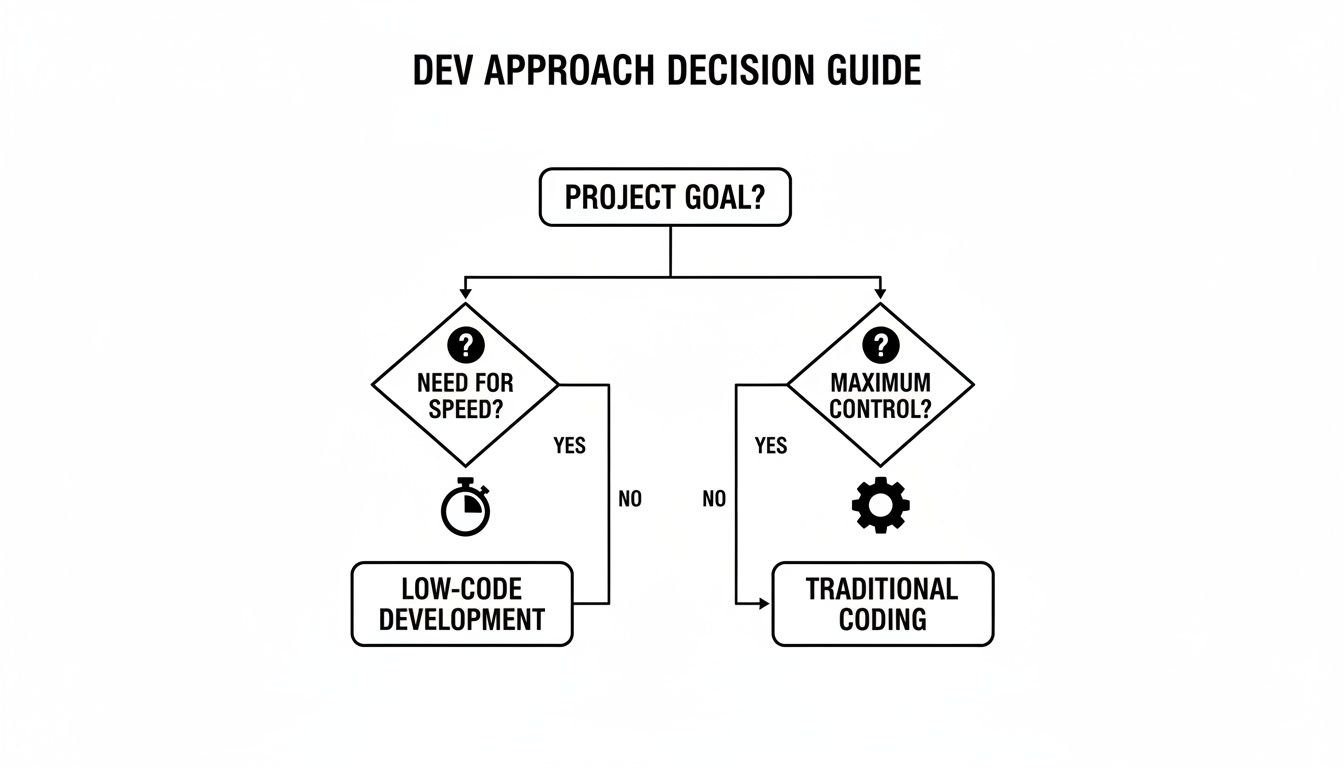
As you can see, if getting to market and validating an idea is your top priority, low-code is the obvious route. But if you're building something that requires unique functionality and you can't afford to compromise on control, traditional development is the only way to go.
When Low-Code Is the Clear Winner
Low-code platforms really shine when time and resources are your biggest hurdles. They offer a powerful shortcut for getting specific kinds of common business applications built and deployed fast.
Here are a few scenarios where low-code is a no-brainer:
- Minimum Viable Product (MVP) Prototyping: Got a business idea you need to test? With low-code, you can spin up a functional prototype in a matter of days or weeks, not months. This gets your concept in front of real users for feedback before you sink a ton of money into a full-scale build.
- Internal Tools and Dashboards: Need an app for managing inventory, a dashboard for the sales team, or a portal for HR onboarding? These are perfect low-code projects. The goal here is pure functionality and efficiency—you don't need a groundbreaking UI to impress internal teams.
- Business Process Automation: If you’re trying to kill a manual workflow, like an approval chain or data entry task, low-code is fantastic. These platforms can connect different systems via APIs and build simple interfaces to get the job done quickly, giving you an immediate ROI by freeing up your team's time.
A huge part of the appeal is the cost savings. By automating common coding tasks and letting non-developers build their own tools, companies often reduce development expenses by as much as 70%. You can dig deeper into these low-code economic impact findings.
When Traditional Development Is Non-Negotiable
As tempting as speed is, some projects have requirements so specific that only hand-coding will do. Trying to shoehorn these into a low-code platform will just lead to painful compromises that defeat the whole purpose of the project.
These are the times when you absolutely need the power of traditional code:
- Complex, Mission-Critical Systems: If you're building the core of your business—think a sophisticated financial trading platform, a sprawling e-commerce marketplace, or your flagship SaaS product—you need custom architecture. These systems require fine-tuned performance, intricate business logic, and a level of scalability that most low-code tools simply can't provide.
- Applications with Unique Performance Demands: Does your app need to process data at lightning speed, run real-time analytics on huge datasets, or execute highly specific algorithms? This is where you need an engineering team to build the system from the ground up for raw performance.
- Deep Hardware or OS-Level Integration: For any software that needs to talk directly to custom hardware, IoT devices, or the operating system itself, traditional development is your only real choice. Low-code platforms operate at a higher level of abstraction and just can't get their hands that dirty.
Ultimately, picking a path is a business decision. By weighing your project against these real-world scenarios, you can match your development approach to what you truly need to accomplish, both now and in the future.
Going Hybrid: The Best of Both Worlds
The whole "low-code vs. traditional development" debate often feels like you have to pick a side. But in reality, the smartest teams don't. They’re finding a middle ground, creating a hybrid model that pulls the best from each approach.
It’s not about settling for a compromise; it's about being strategic. The idea is straightforward: use low-code for what it’s great at—getting things done fast—and save your hardcore coding talent for the truly complex, custom work that needs it. This gives you a more flexible and powerful way to build software.
Marrying Front-End Speed with Back-End Muscle
One of the most effective ways to go hybrid is to build your front-end with a low-code platform and connect it to a custom-coded back-end. Think about building a new customer portal. You could use a visual builder to drag and drop the UI components—dashboards, forms, data tables—and get it all looking right in a matter of days, not weeks.
That slick front-end then talks to a powerful back-end API built with traditional code. This is where your developers can really shine, hammering out complex business logic, fine-tuning database performance, and locking down security for sensitive information. You get an application that feels custom and runs like a dream, but you got it to market way faster.
A Real-World Scenario: The Admin Panel A startup has a powerful, traditionally coded core application. Their engineers are swamped. Instead of pulling them off the main product to build an internal admin panel, the company uses a low-code tool. They connect it to their production database (with read-only access, of course) and whip up a secure, fully functional panel for their support team in under a week.
The Smart Way to Go from MVP to Enterprise Scale
For new products, a hybrid strategy is also a brilliant way to grow. It’s common to launch a low-code MVP to test an idea without sinking a ton of money into it. Once you find that sweet spot of product-market fit and the user base starts to explode, your app's needs will change.
This is where many teams get stuck. A complete rewrite from scratch is a massive, expensive headache. A much better path is to migrate parts of the application from low-code to traditional code, piece by piece, as needed. That simple workflow you built initially might need to be re-engineered with custom code to handle a 10x increase in traffic and complexity.
But this whole strategy hinges on the low-code platform you choose from day one.
The Critical Importance of an Exit Strategy: Code Export
The biggest danger in this game is vendor lock-in. If your low-code platform keeps your application hostage in its own little world, your only way out is a painful, full-scale rebuild. Suddenly, all that speed you gained at the start turns into a mountain of technical debt.
To pull off a successful hybrid strategy, you need a platform that was designed for it. The best modern tools get this and offer full code exportability. This means you can start building with the speed of a low-code or AI-assisted tool and, when you’re ready, export the entire thing as clean, human-readable code (like React).
This export button is your escape hatch. It ensures the work you do today is never a dead end. Your low-code MVP becomes the V1 source code—the actual foundation—that your engineering team can take over, build upon, and scale up using the tools and practices they already know.
FlyDash: A Modern Solution to the Development Dilemma
The debate between low-code vs. traditional development often feels like a trap. You're told to pick one: either the lightning speed of low-code at the cost of customization, or the complete control of traditional coding at the cost of time. But what if that’s a false choice? New tools are emerging that offer a third, much more strategic path.
FlyDash is at the forefront of this new approach, built to dismantle the trade-offs that have plagued development teams for years. It’s based on a simple but powerful idea: you shouldn’t have to choose between building fast and owning what you build. By blending AI-powered app generation with full, exportable code, FlyDash gives both business leaders and experienced developers exactly what they need.
This isn't just another visual builder. It's a genuine development accelerator.
Blending AI Speed with Developer Freedom
The FlyDash experience kicks off with its AI generator. Instead of burning weeks scaffolding a new project, you can simply describe what you need—an inventory management system, a customer support dashboard, or a project tracking tool. The AI then generates a complete, working application in minutes, including a functional frontend, a connected backend, and a provisioned database.
This initial build goes way beyond what typical low-code platforms can do. It delivers a solid, usable foundation that’s ready for customization right out of the gate. This dramatically cuts down the time from concept to a tangible, interactive product, letting teams validate ideas and get solutions into users' hands faster than ever before.
Designed for Collaboration and Real Data
Once the initial app is generated, FlyDash becomes a collaborative workspace. Think Google Docs or Figma, but for building software. Product managers, operations leads, and developers can all jump in and work together in real time, breaking down the communication silos that so often slow projects to a crawl.
- Real-time editing lets multiple team members build and tweak UI components at the same time.
- Live cursors and instant syncing keep everyone on the same page, avoiding the version-control headaches that plague early-stage builds.
- Easy data connections mean you can switch from mockups to real databases, REST APIs, or GraphQL endpoints without friction, getting your app production-ready.
This collaborative core empowers the entire team to shape the final product, ensuring it's perfectly aligned with business goals from day one.
The Power of Ownership: The biggest knock against conventional low-code platforms is vendor lock-in. Your application, your data, and your business logic are all stuck inside a proprietary system. Once you outgrow the platform, your only choice is a painful, expensive, and time-consuming rewrite from scratch.
Eliminating Vendor Lock-In with Code Export
FlyDash tackles the vendor lock-in problem head-on—the very thing that makes so many companies hesitate to adopt faster development tools. At any point, you can export the entire application as clean, human-readable React code.
This feature is a total game-changer. It means your initial investment in speed is never a dead end. The AI-generated application isn’t some black box; it’s simply the V1 of your own codebase.
Your development team can take the exported code, open it in their favorite editor, connect it to your Git repository, and keep building with their standard workflow. This creates a seamless bridge from a rapidly built prototype to a fully-fledged, traditionally managed application.
Ultimately, FlyDash gives you the velocity of low-code without the handcuffs. It acts as a powerful launchpad for initial development while preserving the complete freedom and control that define professional coding, making it a perfect fit for ambitious companies that plan to scale without limits.
Frequently Asked Questions About Low-Code Development
As low-code platforms become more powerful, the old lines separating them from traditional development are starting to fade. This naturally leads to some very real questions about security, long-term viability, and where developers fit into this new picture. Answering these questions is key to moving beyond a simple "low-code vs. traditional" debate and figuring out which tools are right for your specific needs.
Let's dive into some of the most common concerns and clear up a few misconceptions.
Can Low-Code Platforms Actually Meet Enterprise Security Standards?
This is usually the first question on everyone's mind, and for good reason. The short answer is yes, but it’s not a simple checkbox. Top-tier low-code platforms pour massive resources into security, often providing a more robust foundation than many in-house teams could build from the ground up. They come with built-in features like role-based access control (RBAC), detailed audit logs, and certifications for standards like SOC 2 and ISO 27001.
But security is a two-way street. The platform handles the infrastructure, but your team is still responsible for properly configuring the application, managing user permissions, and protecting sensitive data. You can't just "set it and forget it."
For any company dealing with sensitive data, digging into a platform's security posture and data residency options is an absolute must. This is where modern tools like FlyDash offer a compelling advantage. The ability to export the source code means your security team can audit every line before it ever gets deployed, giving you platform speed with in-house verification.
Will Low-Code Make My Developers Redundant?
This fear comes up a lot, but the reality is quite the opposite. Low-code doesn't replace developers; it makes them more valuable. It takes over the tedious, repetitive tasks that eat up their day—things like building standard UI elements, writing boilerplate for forms, or setting up basic database operations.
By automating that grunt work, you free up your senior engineers to focus on the complex, high-impact challenges that really demand their expertise.
- Complex architecture: Designing resilient and scalable backend systems.
- Performance tuning: Optimizing tricky database queries and algorithms.
- Custom integrations: Connecting to legacy or proprietary systems.
- Technical leadership: Mentoring citizen developers and guiding project strategy.
Think of low-code as a force multiplier for your technical team. It lets business users build simple applications, which in turn frees up professional developers to solve bigger, more strategic problems. The whole organization gets more done, faster.
What Happens if We Outgrow the Low-Code Platform?
This is the classic "vendor lock-in" problem, and it's the Achilles' heel of many older low-code tools. If your application is stuck inside a closed, proprietary system, hitting the platform's limits can mean starting over with a painful and expensive rewrite. Your initial speed advantage quickly becomes a massive technical debt.
This is exactly why the new generation of low-code platforms is built on a different philosophy: code exportability.
When a platform lets you export your entire application as clean, human-readable code, it’s a total game-changer. You can use visual or AI-assisted development to get your first version built incredibly fast. If you eventually outgrow the platform, you just export the code.
This gives you a built-in, frictionless exit ramp. Your investment is protected because the app you built becomes the V1 of your source code. Your team can take that exported code, pop it into their Git repository, and continue building on it with their normal tools and processes, completely free of the original platform. It’s a seamless transition from a rapid MVP to a fully scalable, traditionally managed application.
Ready to build faster without giving up control? FlyDash uses AI to generate complete applications with exportable React code in minutes. Eliminate vendor lock-in and empower your team to go from idea to production faster than ever. Start building for free.
Ready to Build Your App?
Turn your idea into a production-ready React Native app in minutes.
Free tools to get you started
Free AI PRD Generator
Generate a professional product requirements document in seconds. Describe your product idea and get a complete, structured PRD instantly.
Try it freeFree AI App Name Generator
Generate unique, brandable app name ideas with AI. Get creative name suggestions with taglines, brand colors, and monogram previews.
Try it freeFree AI App Icon Generator
Generate beautiful, professional app icons with AI. Describe your app and get multiple icon variations in different styles, ready for App Store and Google Play.
Try it freeFrequently Asked Questions
RapidNative is an AI-powered mobile app builder. Describe the app you want in plain English and RapidNative generates real, production-ready React Native screens you can preview, edit, and publish to the App Store or Google Play.