Boost Your Team: how to improve developer productivity in practice
Discover practical steps on how to improve developer productivity with proven workflows, metrics, and AI tools.
By Parth
17th Jan 2026
Last updated: 17th Jan 2026
For years, engineering leaders have been stuck in a trap, chasing developer productivity with metrics that are easy to count but tell the wrong story. We've all been there, looking at dashboards filled with commits per week, story points burned down, or the most infamous metric of all: lines of code.
It feels like you're measuring something, but these numbers often create the wrong incentives and miss the point entirely.
Why Traditional Productivity Metrics Are Holding Your Team Back

The old way of thinking treats software development like a factory assembly line. It’s based on the flawed assumption that more activity automatically equals more value. But any experienced engineer knows that's just not true.
Think about it: a developer who spends three days thinking and then writes 50 elegant lines of code to fix a critical, complex bug is far more productive than someone who churns out 500 lines of messy code for a minor feature. The real value is in the problem-solving, not the keystrokes.
The Hidden Costs of Outdated Metrics
When you focus on these kinds of vanity metrics, you don't just get a distorted picture of performance—you actively damage your team's culture and the quality of your product. Developers are smart; if you measure them on output, they’ll optimize for output, not for creating great software.
This inevitably leads to some serious problems:
- Racking up Technical Debt: To hit their numbers, developers might cut corners on testing, skip documentation, and write code that's hard to maintain.
- Killing Collaboration: Why would a developer pause their work to help a teammate if it doesn’t show up in their personal stats? Individual metrics can turn a team into a group of siloed contributors.
- Stifling Innovation: Real breakthroughs come from experimentation, research, and deep thinking. None of that looks good on a commit graph, so it gets pushed aside.
- Driving Burnout: The constant pressure to "look busy" by pushing code creates a culture of surveillance, not trust. This is a fast track to stress, frustration, and high turnover.
To get a real sense of what matters, we need to move away from measuring busyness and start focusing on what actually drives business results. This means looking at things like system stability, deployment frequency, and how long it takes to fix issues when they pop up.
Here’s how that mental shift looks in practice:
Shifting from Outdated Metrics to Modern Measures
| Metric Category | Outdated Metric (What to Avoid) | Modern Metric (What to Adopt) |
|---|---|---|
| Code Volume | Lines of Code (LOC), number of commits | Code Churn, Code Complexity |
| Feature Velocity | Story Points completed, tickets closed | Cycle Time, Lead Time for Changes |
| Individual Output | Commits per developer | Impact on business goals, team collaboration |
| System Stability | Number of bugs reported | Change Failure Rate, Mean Time to Recovery (MTTR) |
Adopting these modern metrics helps align the engineering team's work directly with business outcomes, fostering a healthier and more genuinely productive environment.
The most valuable engineering work often happens in moments of quiet contemplation that produce zero immediate output. Trying to measure productivity with a stopwatch completely misses the creative, problem-solving heart of software development.
It's Time for a New Conversation
To make real progress, we have to change the questions we're asking. Instead of, "How can we make our developers write code faster?" we need to ask, "How can we remove the friction that slows our developers down?"
This is a fundamental shift from focusing on individual activity to improving systemic efficiency. It's about giving your team better tools, clearing roadblocks, and building a culture of psychological safety where people can do their best work. This guide will give you actionable strategies to get there, moving beyond flawed metrics to build a truly high-performing engineering team.
Cut Out the Friction and Watch Productivity Soar

Sometimes, the biggest wins in developer productivity don't come from a flashy new tool. They come from hunting down and eliminating the small, everyday obstacles that drain time, energy, and focus.
Think about it: a confusing development environment, a vague task, an unnecessary meeting. On their own, they're just minor annoyances. But they stack up, compounding into a massive drag on your team's output.
So, instead of asking "How can we make developers faster?" let's start asking, "What's slowing them down?" When you clear the path of these hidden drains, you create an environment where deep, focused work can actually happen.
Protect Deep Work with Asynchronous Communication
Constant interruptions are the mortal enemy of a developer in the zone. Every Slack ping or "got a sec?" shoulder tap can shatter a complex mental model. In fact, research shows it can take over 20 minutes to get back on track after a single interruption.
This is where an async-first culture becomes your secret weapon.
It's not about eliminating communication; it's about shifting expectations. Instead of demanding instant replies, you create a system that respects a developer's need for long stretches of uninterrupted time.
Here are a few practical ways to do this:
- Default to long-form: Encourage detailed tickets, well-written docs, or thoughtful emails for anything that isn't a true emergency.
- Schedule "office hours": Set aside specific, predictable times for meetings and live collaboration. This leaves the rest of the day free for deep work.
- Embrace status indicators: Get the team in the habit of using "Do Not Disturb" or "Focus Time" statuses to signal when they're off-limits.
A team that masters async communication isn't just more productive; they're less stressed. They trade reactive, fragmented work for focused, proactive problem-solving. It’s a game-changer.
This simple cultural shift gives developers control over their own schedules, allowing them to tackle big problems without constantly looking over their shoulder.
Untangle Your Development and Review Processes
A clunky, bureaucratic development process is another classic productivity killer. Long-running feature branches, messy merges, and code reviews that drag on for days all put the brakes on your team’s momentum.
A great place to start is with your branching strategy. Many teams find huge success with trunk-based development. By having everyone commit small, frequent changes to a single main branch, you sidestep the merge conflicts and integration headaches that plague complex branching models.
The pull request (PR) process is another high-impact area. A PR that sits in a queue for days doesn't just block a feature; it forces the author to completely context-switch back to that code days later, wasting even more time.
Imagine a team whose average PR review time was over 48 hours. They decided to implement two simple rules:
- Keep PRs small and focused. No PR should touch more than a handful of files or tackle more than one core change.
- Block out daily review time. Every developer dedicates one specific hour each day just for reviewing code.
The outcome? Their average review time plummeted to under four hours. That simple change dramatically sped up their entire delivery cycle.
Lighten the Cognitive Load by Demanding Clarity
Cognitive load is the amount of mental effort you're using at any given moment. When a developer has to decipher ambiguous requirements, hunt for scattered documentation, or navigate a maze of microservices just to get set up, their cognitive load goes through the roof.
There’s simply less brainpower left for the actual work: writing great code.
One of your most important jobs as a leader is to reduce that burden by providing absolute clarity.
- Define "Done" like you mean it. A task ticket should be a self-contained package with everything needed to start, including clear acceptance criteria, designs, and API contracts.
- Maintain a single source of truth. Your documentation needs to be centralized, current, and searchable. If a developer has to ask someone where to find information, the system is broken.
- Simplify the toolchain. Be ruthless about the tools you add. Every new platform or library adds overhead. Regularly audit your stack and ditch anything that isn't pulling its weight.
When you minimize the mental gymnastics required just to understand the work, you free up your team’s most precious resource.
Putting AI and Automation to Work for Your Team

The conversation around AI in software development has moved past simple code completion. We're now seeing AI tools that can act as a genuine force multiplier for engineering teams, handling everything from writing unit tests and generating boilerplate to scaffolding entire applications from a single prompt.
This isn't just about small efficiency gains. It's a fundamental shift in how development gets done. By taking on the repetitive, low-value tasks that clog up a developer's day, you free up their mental bandwidth to focus on what really matters: solving tough business problems and shipping innovative products.
From Code Completion to Full Application Generation
The real leap forward is the move from AI-assisted coding to AI-driven application building. Imagine an operations manager who needs a new dashboard to track inventory. Instead of writing a detailed spec and waiting weeks for a developer to get to it, they can now describe their needs in plain English.
Platforms like FlyDash are turning this into a practical reality. An operations lead can provide a prompt like, "Build me a dashboard that shows real-time inventory from our production database and alerts me when stock is low," and the AI generates a complete, working application. It handles the frontend UI, the backend logic, and the necessary database connections.
This kind of automation can shrink the development cycle from weeks or months down to minutes. For startups and other fast-moving teams, that speed is a massive advantage. It means finance leads, product managers, and founders can build and deploy the internal tools they need to run the business, without pulling developers away from core product work.
The industry is already feeling this shift. In the 2025 DORA report from Google, a massive 90% of software professionals reported using AI in their workflows—that’s a 14% jump from the previous year. And it’s delivering real results: over 80% of respondents saw better productivity, and 59% noted improved code quality. You can dive into the full DORA report findings on Google's blog to see just how much AI is reshaping software delivery.
Navigating the AI Trust Paradox
Despite the high adoption rates, a major hurdle remains: the "trust paradox." Many developers use AI assistants but don't fully trust the code they produce. They’re right to be cautious, worrying about subtle bugs, security holes, or just plain unmaintainable code.
This is where a human-in-the-loop model is critical. The goal isn't to replace developers but to augment them. The best tools strike a careful balance, pairing AI-driven speed with the assurance of human oversight.
Here’s what that balance looks like in practice:
- Real-Time Collaboration: The tool should feel like a multiplayer design app, where a product manager and a developer can build and refine an AI-generated tool together, ensuring it meets the exact business need.
- Full Code Access: Developers must never feel locked into a black box. The ability to open a full code editor at any time to inspect, tweak, and extend the AI-generated code is non-negotiable. It’s the ultimate safety net.
- Seamless Git Integration: Any new tool has to fit into existing workflows. The ability to connect a Git repository and export standard, deployable code means teams can get the speed benefits of AI without throwing out their engineering best practices.
The most powerful AI development tools aren't those that try to replace human developers, but those that act as their most trusted, highly-skilled assistants. They handle the grunt work, allowing the developer to focus on architecture, strategy, and creative problem-solving.
This approach resolves the trust paradox by giving developers the final say. They can use AI to get 90% of the way there and then apply their expertise to refine the final 10%, guaranteeing both quality and maintainability.
Automating Toil to Unlock Real Productivity
At the end of the day, the biggest impact AI and automation have on productivity comes from eliminating toil. Toil is all that manual, repetitive, and automatable work that provides little lasting value—think setting up build pipelines, writing CRUD endpoints, or configuring boilerplate for a new service.
Every hour a developer spends on these tasks is an hour they aren't spending on high-impact work. Automating it away is one of the most direct routes to boosting developer productivity.
Take, for instance, a finance lead at a startup who needs a tool to pull data from their Stripe account via a REST API and visualize revenue. A few years ago, that would have been a multi-day project for a developer. With an AI-powered platform, the finance lead can generate a functional app themselves, connecting to the real API and getting the insights they need almost instantly.
This frees up the developer to focus on a mission-critical feature for the core product. When you empower non-technical team members to build their own tools, you create a more efficient organization and a more satisfied, impactful engineering team.
Build a Culture of High-Impact Collaboration
Developer productivity isn't just about individual output. You can have a team of brilliant coders, but if they aren't working together effectively, you'll never see their full potential. The real magic happens when you move from a collection of siloed individuals to a team that’s truly firing on all cylinders.
This all starts with a culture built on psychological safety. It’s a simple but powerful idea: people need to feel safe to take risks. Can a junior dev ask a "stupid" question without feeling embarrassed? Can a senior engineer admit they made a mistake? When the answer is yes, you unlock a team’s true problem-solving power.
Without that safety net, people waste incredible amounts of energy just trying to protect themselves. Instead of flagging a potential issue, they stay quiet. Instead of asking for help and solving a problem in an hour, they struggle alone for days.
Turn Code Reviews into Learning Opportunities
Code reviews are often the canary in the coal mine for team culture. Are they treated as adversarial interrogations, or are they genuine opportunities for collaboration? The goal is to shift the entire mindset from "finding what's wrong" to "making our code better, together."
Here’s how you can nudge your team in the right direction:
- Critique the code, not the coder. It’s a subtle but crucial distinction. Instead of saying, "You forgot this edge case," try, "What if we handle this edge case here?" It frames the review as a collaborative problem-solving session.
- Let the robots handle the small stuff. Use linters and formatters to automate debates about style and syntax. This frees up human brainpower to focus on what really matters: logic, architecture, and catching tricky bugs.
- Don't let pull requests go stale. A PR sitting unreviewed for days is a massive momentum killer. Set clear expectations for review turnaround times to keep the whole team moving.
A great code review is a conversation, not an interrogation. It should be a moment for mentorship and knowledge sharing that strengthens both the codebase and the team.
When you get this right, code reviews stop being a chore and become one of your best tools for leveling up the entire team.
Know When to Pair and When to Mob
Deep, focused solo work is absolutely essential. But some problems are just too thorny for one person to tackle alone. That's when you bring in structured collaboration like pair and mob programming.
Pair programming is perfect for complicated but well-defined tasks. Having two developers at one keyboard is fantastic for catching bugs as they happen and sharing deep, specific knowledge about a tricky part of the system. Think of it as a high-bandwidth knowledge transfer.
Mob programming, on the other hand, is your go-to for big, ambiguous challenges. When you're stuck on a major architectural decision or trying to solve a critical production fire, getting the whole team focused on the problem at once can be a game-changer. It breaks down information silos and ensures everyone is bought into the solution.
Break Down Silos with Shared Tools and Goals
True collaboration doesn't stop at the engineering team's door. The biggest productivity gains come when engineering, product, and operations are all on the same page, looking at the same data.
Imagine an ops manager at a startup needs to keep an eye on a new feature's performance. The old way involved filing a ticket and waiting. A better way? They use a tool like FlyDash to simply describe the dashboard they need, and AI generates a working tool that pulls in live production data.
If they spot an anomaly, they don't have to write a long email. They can just share a direct link to the live data with a developer. Now, they're looking at the same screen, inspecting the same information, and can work together to find the root cause and ship a fix. That’s what happens when you combine the right culture with the right tools.
This kind of AI-assisted workflow is quickly becoming the norm. Recent JetBrains research found that 85% of developers are already using AI tools. And with 68% expecting employers to require AI skills soon, platforms that facilitate this kind of collaboration are no longer a luxury—they're a necessity. You can dive deeper into these trends in the JetBrains State of Developer Ecosystem 2025 research.
Measure What Matters with SPACE and DORA Frameworks
If you can't measure developer productivity properly, you can't improve it. It's that simple. For years, teams have been stuck on useless (and frankly, insulting) metrics like lines of code. The real breakthrough comes when you stop tracking individual output and start looking at the health of the entire system.
That’s where two incredible frameworks, SPACE and DORA, come into play.
Think of them less as tools for ranking developers and more as diagnostic instruments for your engineering practice. They help you pinpoint the systemic friction that's slowing everyone down, allowing you to see the complete picture of your development lifecycle.
Getting a Pulse on Performance with DORA Metrics
The DORA (DevOps Research and Assessment) framework gives you a quick, high-level snapshot of your software delivery performance. It’s built on four key metrics that are elegantly simple but incredibly powerful. They tell you how well your team ships high-quality software, fast.
Here’s the breakdown:
- Deployment Frequency: How often are you pushing code to production? The best teams do it on demand, multiple times a day.
- Lead Time for Changes: How long does it take for a committed piece of code to actually go live? This measures the true speed of your entire pipeline.
- Change Failure Rate: What percentage of your deployments blow up in production? This is your gut-check on quality and stability.
- Time to Restore Service: When things inevitably break, how quickly can you fix them? This shows your team's resilience.
The beauty of DORA is how these metrics balance each other out. You can’t just goose your Deployment Frequency by shipping shoddy code; your Change Failure Rate would skyrocket, immediately telling you there's a problem. For example, using a platform like FlyDash to automate the creation of internal dashboards directly impacts these metrics by enabling quicker, more frequent, and more reliable deployments.
Going Deeper with the SPACE Framework
While DORA is fantastic for measuring throughput and stability, the SPACE framework offers a much more holistic view. It brings the human element into the equation, recognizing that a burnt-out team isn't a productive one, no matter how fast their CI/CD pipeline runs.
SPACE is an acronym for five key dimensions:
- Satisfaction and Well-being: Are your developers happy? Are they burning out? You can find out through simple surveys on tool satisfaction, work-life balance, and team culture.
- Performance: This is all about the outcome. Is the software high-quality? Is it reliable? Does it actually help customers and hit business goals?
- Activity: This is a raw count of development actions—things like commits, pull requests, and deployments.
- Communication and Collaboration: How effectively do people work together? Look at the quality of code reviews, documentation, and how knowledge flows between teams.
- Efficiency and Flow: Can developers get their work done without constant interruptions? This is where you measure things like cycle time and the ability to find "deep work" time.
The real power of SPACE is its flexibility. You don't need to measure everything at once. You can pick a few metrics from different categories to get a balanced view that makes sense for your team's current challenges and goals.
For instance, you could track developer satisfaction (Satisfaction) alongside the change failure rate (Performance) and pull request review time (Communication). This combination paints a rich picture of team morale, technical quality, and collaborative health all at once.
This is where you see how psychological safety, solid reviews, and genuine teamwork create a foundation for real innovation.
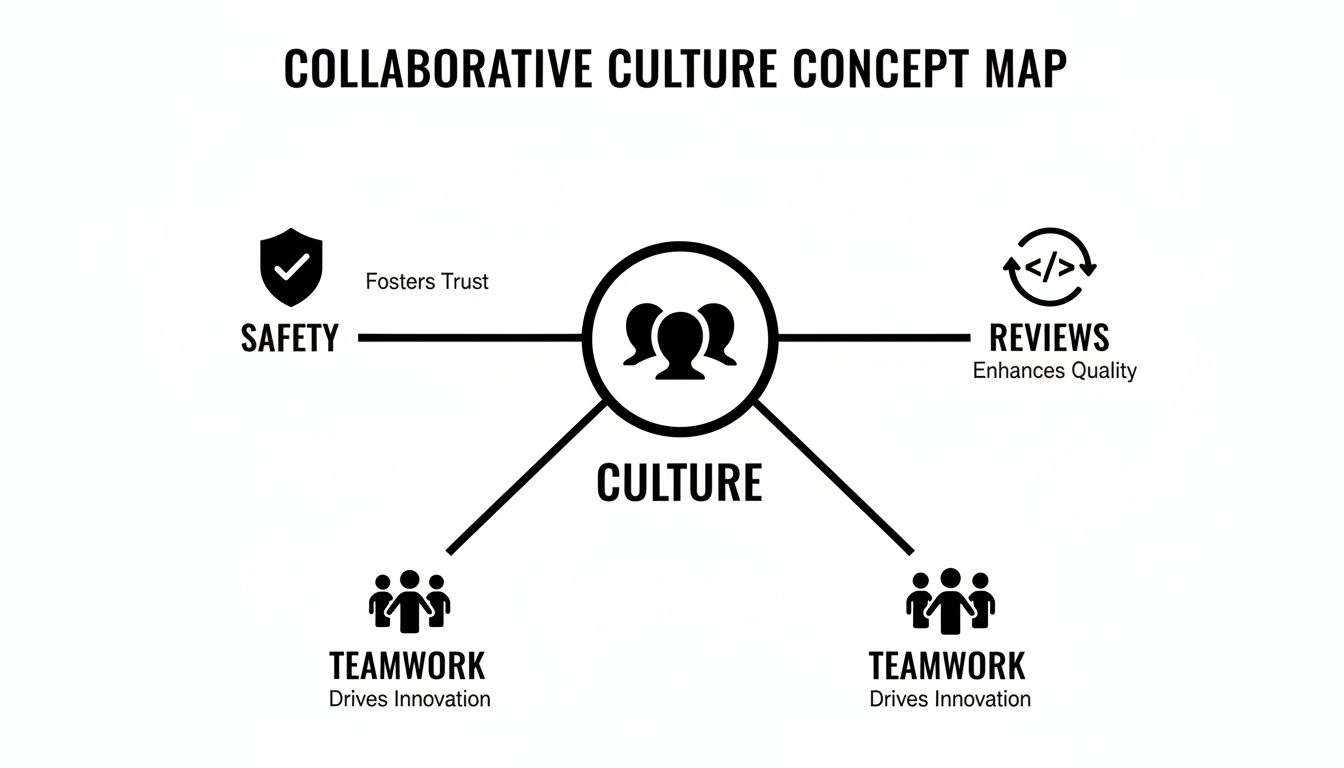
The image above really drives home the point: productivity isn't just about tools; it's deeply rooted in how people interact and support one another.
Putting It All Together
The goal here isn't to get lost in a sea of dashboards. It's about using these frameworks to ask smarter questions. If your Lead Time for Changes is creeping up, is it a slow pipeline, or are code reviews becoming a bottleneck? If developer satisfaction is tanking, is it because of clunky tools or constant context switching?
Even with AI tools on the rise, organizational friction can kill any potential gains. The latest research backs this up. For example, Booking.com saw a 16% productivity lift from their AI rollout because they focused on reducing toil in testing and reviews. This simple change helped them go from deploying once a week to multiple times per day. You can dig into more trends like this in Atlassian's 2025 State of Developer Experience Report.
By blending metrics from DORA and SPACE, you create a powerful, balanced scorecard. You get the hard data on delivery from DORA, and you enrich it with the human-centric insights from SPACE. This is how you stop guessing and start making targeted investments that actually improve your team's productivity and well-being.
Common Questions About Developer Productivity
Making real, lasting improvements to how your team works always sparks a few questions. Let's tackle some of the most common ones I hear from engineering leaders.
How Do I Get My Team to Actually Adopt New Processes?
Engineers are often skeptical of process changes, and for good reason—too often, they feel like top-down mandates that just add friction. If you want buy-in, you have to position any change as an experiment to solve a real problem they already feel.
Don't roll out a permanent, sweeping change. Instead, pick one specific, nagging pain point, like PRs that sit for days or a local development environment that's a nightmare to set up.
Then, propose a small, time-boxed trial. You might say, "For the next two sprints, let's try a guideline that no PR can be over 200 lines of code. The goal is to see if we can get reviews done faster." This approach gives your team a voice and makes it feel like you're solving the problem with them, not doing something to them.
Once the trial is over, get everyone together to discuss the results. Was it better? What were the trade-offs? When your team sees you’re genuinely invested in making their work easier, not just tracking their every move, they'll be far more open to new ideas.
We're Drowning in Tools. How Do We Pick Ones That Genuinely Help?
The market is saturated with platforms that all claim to be the magic bullet for productivity. It's incredibly easy to get caught in "tool sprawl," where every new dashboard just adds another layer of cognitive load without solving the core issue.
Before you even consider a new tool, ask your team this simple question: "Does this automate a tedious, manual task, or does it just put a digital wrapper on a broken process?"
The goal is always to eliminate toil, not to create another screen to stare at.
A great example is an AI-powered tool for building internal applications. It's valuable because it automates a task that used to eat up days of a developer's time—spinning up custom dashboards from the ground up. In contrast, another project management app that just shows the same tickets in a slightly different layout? That's probably just adding noise.
Always run a small pilot with a few engineers to see how a new tool performs in the real world before you commit to a full-team rollout.
How Can We Measure What's Working Without It Feeling Like Big Brother?
This is probably the most important question of all. The secret is to stop focusing on individual output and start measuring the health of your entire system.
Frameworks like DORA and SPACE were created for this very reason. They help you look at the big picture—the efficiency and stability of your entire software delivery pipeline—not the number of lines an individual engineer wrote.
Start with a couple of high-level DORA metrics, like Deployment Frequency (how often are you shipping?) and Change Failure Rate (how often do your deployments cause problems?). These numbers give you a clear, objective view of your team's ability to deliver value reliably.
Pair that quantitative data with a simple, anonymous developer satisfaction survey, which is a key component of the SPACE framework. This gives you a pulse on morale, burnout, and overall team well-being.
The conversation should shift from "Your commit count was low this week" to "Our lead time for changes is creeping up. Let's dig into our process and find the bottleneck together." This reframes measurement as a collaborative problem-solving tool, not a surveillance tactic.
Ready to eliminate the productivity drains that frustrate your team most? With FlyDash, you can build the internal tools and dashboards you need in minutes, not weeks, just by describing them. Free up your engineers to focus on what they do best: building your core product. Build your first app with FlyDash.
Ready to Build Your App?
Turn your idea into a production-ready React Native app in minutes.
Free tools to get you started
Free AI PRD Generator
Generate a professional product requirements document in seconds. Describe your product idea and get a complete, structured PRD instantly.
Try it freeFree AI App Name Generator
Generate unique, brandable app name ideas with AI. Get creative name suggestions with taglines, brand colors, and monogram previews.
Try it freeFree AI App Icon Generator
Generate beautiful, professional app icons with AI. Describe your app and get multiple icon variations in different styles, ready for App Store and Google Play.
Try it freeFrequently Asked Questions
RapidNative is an AI-powered mobile app builder. Describe the app you want in plain English and RapidNative generates real, production-ready React Native screens you can preview, edit, and publish to the App Store or Google Play.