Build Apps Fast with an AI Powered App Development Platform
Discover how an AI powered app development platform lets you build custom software from simple text. Learn how it works, key features, and real-world uses.
By Suraj Ahmed
9th Feb 2026
Last updated: 9th Feb 2026
Ever wished you could just describe an app you need and have it magically appear? That's the core idea behind an AI-powered app development platform. It acts like a brilliant developer on standby, ready to build internal tools, dashboards, or client portals from simple text descriptions.
The New Era of AI-Powered App Creation
Think of it like this: you tell a master chef you want something savory with a hint of citrus and a rich, creamy texture. The chef doesn't need a detailed recipe; they understand the goal and immediately start cooking. AI app builders work on the same principle.
You don't write lines of code. Instead, you describe your business problem in plain English. An operations manager could say, "I need a real-time inventory dashboard that shows current stock levels and highlights items that are running low." The AI takes that prompt, designs the interface, writes the backend logic, connects to your data, and spins up a working application in minutes.
Democratizing Software Development
This completely changes the game for who can build software. It tears down the traditional walls of needing to know complex programming languages and waiting through long development cycles. Suddenly, non-technical team members—the people who actually know the business problem inside and out—can build the exact tools they need to solve it.
This shift is turning subject-matter experts into creators, and the market is responding in a big way. The global AI software platform market, which powers tools like FlyDash, is seeing massive growth. Valued at USD 26.65 billion in 2025, it's on track to hit USD 88.19 billion by 2034, all thanks to the huge demand for automation in business. You can dive deeper into the numbers in the full market analysis.
Collaboration Meets Creation
These new platforms also foster a whole new kind of teamwork. Imagine a Google Docs or Figma environment, but instead of a document or design, you're building a live application. Startup founders, finance leads, and operations managers can all jump into the same workspace and build together.
An AI development platform transforms app creation from a siloed, technical task into a collaborative, creative process. It allows teams to iterate on ideas in real-time, bridging the gap between business needs and a functional software solution instantly.
This live, interactive building process shortens the feedback loop from weeks to minutes. Stakeholders can see the app come to life and give input on the spot, ensuring the final product is a perfect fit for the business needs right from the get-go. The result? Faster launches, lower costs, and custom software that actually solves real problems with incredible speed and precision.
How Does This Compare to the Old Way?
It helps to see a direct comparison to understand just how different this approach is. Traditional development has its place, but for many internal business applications, AI-powered platforms offer a clear advantage.
| Aspect | Traditional Development | AI-Powered Platform (e.g., FlyDash) |
|---|---|---|
| Speed | Weeks or months from idea to deployment. | Minutes or hours to a functional app. |
| Cost | High, involving salaries for developers, designers, and project managers. | Significantly lower, often a subscription-based model. |
| Skill Requirement | Requires specialized coding skills (Python, JavaScript, SQL, etc.). | No coding required. Anyone can build using plain English. |
| Iteration | Slow and costly. Changes require new development cycles. | Instant. Make changes on the fly and see them live. |
| Accessibility | Limited to the engineering team. | Open to any team member with a business need. |
As you can see, the differences are stark. For businesses that need to move fast and empower their teams, AI-powered development isn't just an alternative—it's a much more efficient path forward.
How AI Transforms Your Ideas into Working Apps
Ever wondered how a simple sentence can become a fully functional application? It might feel like magic, but it’s actually a well-defined process. Think of it less like a magic wand and more like having an incredibly fast architect who also happens to be the entire construction crew.
It all starts with your idea, described in plain English. This is your prompt. For example, you might type, "Build an application to track project tasks, with statuses for 'To Do,' 'In Progress,' and 'Done,' and let me assign tasks to team members."
That one instruction is the spark. The AI doesn't just guess what you want; it meticulously breaks down your request into its essential parts, identifying the key pieces (tasks, team members), how they relate to each other (assignments), and what they need to do (change statuses).
The Three Pillars of AI App Generation
From that single prompt, the AI gets to work building the three core layers of any modern app—all at the same time. This parallel process completely replaces the slow, sequential work that would normally take a team of specialized developers weeks or months to coordinate.
- The Frontend (The User Interface): This is everything your users see and interact with—the buttons, forms, tables, and overall layout. The AI designs a clean, logical interface based on your description, creating a visual experience that makes sense for the job at hand.
- The Backend (The Engine Room): This is all the behind-the-scenes logic that makes the app tick. The AI writes the code that handles data processing, user authentication, and business rules. It’s the engine that powers the car, invisible to the driver but absolutely critical.
- The Database (The Memory): This is where all the application's information is safely stored. The AI instantly designs a database structure to hold your data—in our example, creating tables for projects, tasks, and users—making sure everything is organized and easy to access.
This infographic shows just how direct the path is from your initial idea to a live application.
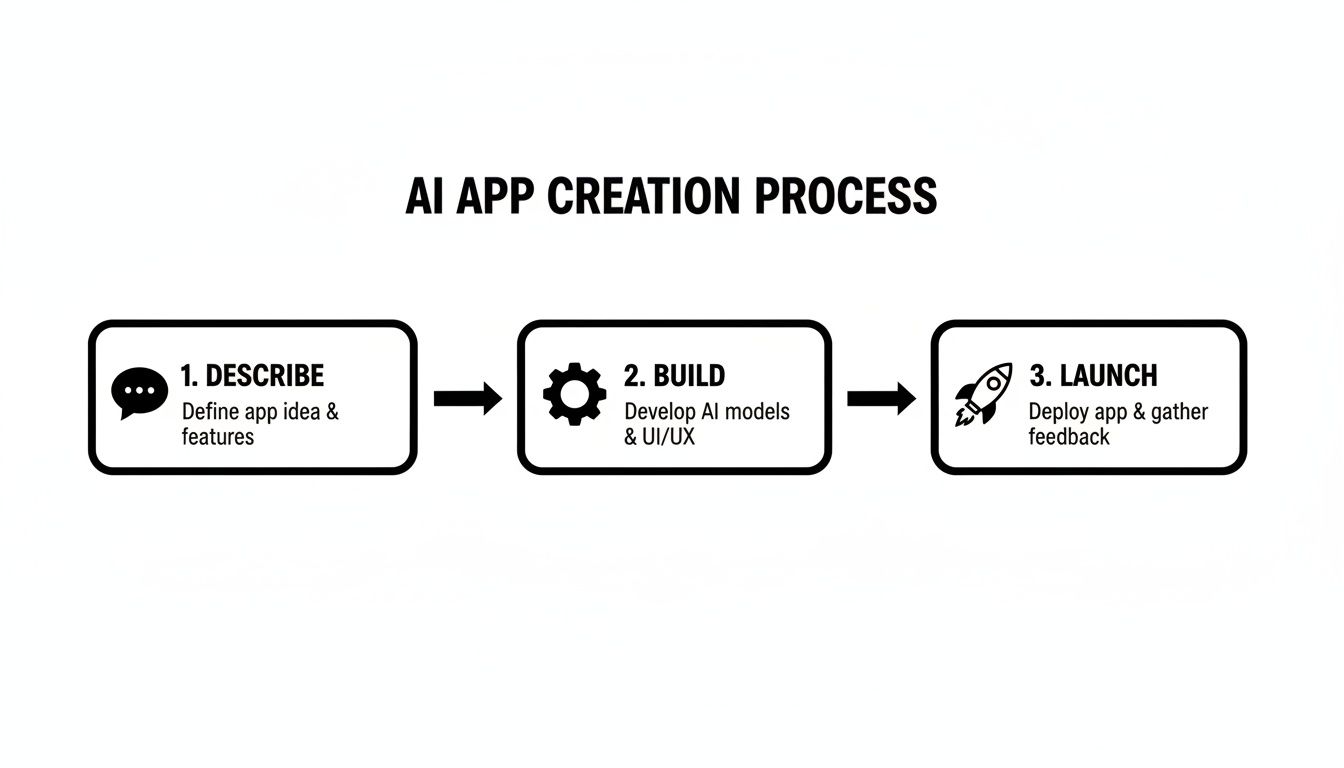
As you can see, the process condenses a complex development cycle into three simple stages that anyone can manage.
Connecting to Your World of Data
An app on its own is useful. But an app that talks to your existing business data? That’s a game-changer. This is where AI platforms really come into their own, as they are built to integrate smoothly with the tools and databases you already rely on.
You can simply tell the AI to connect to an external data source, like a PostgreSQL database or a third-party service through a REST API. For instance, you could add to your prompt: "Connect to our customer database and pull in user information for task assignments." The AI will then generate the necessary connections, allowing your new app to read from and write to your established systems in real time.
This capability is fueling some serious market growth. The AI apps market was valued at USD 2,940.0 million in 2024 and is expected to rocket to USD 26,362.4 million by 2030. This trend mirrors what’s happening in the broader low-code space, where 81% of companies now see these platforms as strategically important. They empower non-technical users to build the exact tools they need, right when they need them. You can dive deeper into this expansion in this detailed market report.
By understanding natural language, generating a full-stack application, and integrating with existing data sources, an AI-powered app development platform acts as your complete, on-demand development team. It translates business needs directly into software, sidestepping the typical delays and complexities of traditional coding.
The entire journey—from a simple prompt to a fully integrated, working app—takes just a few minutes. The platform handles the boring, repetitive coding, freeing you up to focus on what matters: refining the app’s functionality and making sure it perfectly solves your business problem.
Must-Have Features of a Modern AI Platform
When you start looking at different AI-powered app development platforms, it's easy to get lost in a sea of features. But from my experience, a handful of capabilities truly separate the game-changers from the hype. It’s all about finding a tool that helps you build fast today without boxing you in tomorrow.
The absolute first thing to check for is a solid integration layer. Your business doesn’t exist in a vacuum; it runs on databases, third-party services, and a whole network of internal APIs. A top-tier platform has to connect to these data sources smoothly and securely, letting you build apps that read from and write to your live systems.
This is what turns a simple app builder into a true command center. Think about it: an inventory management tool that hooks directly into your PostgreSQL database, or a customer dashboard that pulls fresh data from your CRM's REST API. That's where the real power lies.
Fostering Real-Time Collaboration
App development shouldn't be a solo mission—it's a team sport. The best platforms get this, offering real-time collaboration that feels a lot like working in Google Docs or Figma. This means your entire team, from operations managers to developers, can jump into the same project and build, edit, and comment all at once.
This kind of collaborative environment completely changes the game. It kills the slow, painful feedback loop. Instead of waiting days for a developer to push an update, a finance lead can point out a change on a dashboard, and a product manager can watch it happen live. You end up with a tool that actually meets the business needs because the business experts helped build it.
The ability to collaborate in real-time transforms app development from a series of handoffs into a fluid, creative conversation. It aligns stakeholders and builders in a shared environment, ensuring the final tool is a perfect fit for its intended purpose.
This approach doesn't just speed things up; it makes the final product better. When the people who feel the pain point are involved in creating the solution, you get a tool that actually solves their problems.
Escaping Vendor Lock-In with Code Export
Let’s talk about one of the biggest fears with low-code tools: vendor lock-in. What if you build a critical application and then outgrow the platform? The smartest platforms offer a crucial "escape hatch" to prevent this: the ability to export clean, human-readable code.
This is a non-negotiable feature. It means you can start building with simple English prompts, but you're never trapped. At any moment, you can export the entire application as standard code—say, a React frontend and a Node.js backend. This gives you three massive advantages:
- Ultimate Flexibility: Your developers can grab the exported code and add any custom logic or complex feature they can dream up.
- Total Ownership: The code is yours, period. You can host it on AWS, Google Cloud, Azure, or even your own servers.
- Future-Proofing: Your application isn’t stuck in one proprietary system. It’s built to last and scale with your business.
The Hybrid Approach for Maximum Power
The most powerful platforms are the ones that blend the simplicity of no-code with the depth of custom development. This hybrid model is a win-win. A business user can generate the first version of an app using natural language, and then a developer can jump in to fine-tune the logic or connect a tricky API.
Look for tools that have an integrated code editor and are compatible with Git. This lets your technical folks work right inside the platform, making precise changes and managing versions just like they would in their normal workflow. This dual functionality ensures your AI-powered app development platform isn’t just a launchpad, but a complete environment for the entire lifecycle of your application.
Real-World Problems Solved with AI-Generated Apps

The real test of any technology isn't how it works, but what it does for you. While the inner workings of an AI powered app development platform are fascinating, it's their knack for solving everyday business headaches that makes them so valuable. Let's move past the theory and dive into how these platforms help build the exact internal tools teams need to get work done.
These aren't just minor tweaks to a workflow; they're custom-built solutions to specific, nagging problems. The best part? They're often built by the very people feeling the pain—the operations manager buried in spreadsheets, the startup founder juggling sales leads, or the finance lead chasing down receipts. They no longer have to wait in line for a developer. They can just build what they need.
This shift is fundamentally changing how software gets made. The global mobile app development market, which hit USD 252.89 billion in 2023, is on track to reach a staggering USD 626.39 billion by 2030. A huge driver of that growth is the rise of low-code and no-code platforms, which fill the gap between the massive demand for apps and the limited supply of developers. AI is pouring fuel on this fire, with 84% of developers expected to use it by 2025 to build production-ready applications. You can dig deeper into these mobile app development statistics to see just how big this trend is.
Taming Operational Chaos with Custom Tools
Think about Sarah, an operations manager who spends hours every week trying to reconcile inventory spreadsheets. The data is never quite live, which leads to frustrating stockouts or expensive over-ordering. It’s a classic bottleneck that quietly drains time and money from the business.
Sarah needs a real-time inventory dashboard. Using a platform like FlyDash, she can simply describe what she wants: "Create an inventory dashboard that connects to our warehouse database, shows current stock levels for each product, and sends an email alert when any item's quantity drops below 50 units."
In just a few minutes, the AI generates a complete application. She gets a clean UI with a table of all her products, their live counts, and their status. Behind the scenes, the tool has already connected to the company’s database and built the logic to trigger those low-stock alerts. Sarah didn’t have to write a single line of code, but she solved a problem that has plagued her team for months.
Building a Simple CRM for a Growing Startup
Now, picture Alex, a startup founder managing their first dozen customers in a messy spreadsheet. It worked at first, but now the company is growing. Details are getting lost, follow-ups are being missed, and deals are slipping through the cracks. Alex needs a basic Customer Relationship Management (CRM) tool, but the big-name options are way too expensive and complicated for a small team.
Alex’s prompt to an AI platform is simple: "Build a simple CRM to manage customer contacts. It should include fields for name, company, email, and the last contact date. I also need a way to add notes for each interaction."
The platform delivers a functional, no-frills CRM. It has a form for adding new contacts, a searchable list of everyone in the pipeline, and a detail view where Alex can log notes from calls and meetings. It's exactly what the startup needs to stay organized and look professional, without the intimidating feature bloat or price tag of an enterprise system.
"Being able to go from identifying a workflow issue to having a working tool in the same afternoon is a massive productivity boost. We can build and refine our internal apps in real-time, right alongside the teams that will use them every day. It's a completely different way of working."
Creating Custom Financial Workflows
Finally, imagine David, a finance lead who is completely bogged down managing expense approvals through an endless chain of emails. Receipts get lost, approvals stall, and trying to track spending is a nightmare. This manual process isn't just slow; it's a recipe for mistakes.
David can use an AI platform to build a custom expense approval app from scratch. He describes his ideal workflow: "I need an expense submission app where employees can upload a receipt, enter the amount and category, and submit it for approval. Managers should get a notification and be able to approve or deny the request with one click."
The resulting app automates the entire process. It gives employees a simple form, provides managers with a dashboard to review all pending requests, and keeps a central record of every submission's status. What was once a chaotic, email-driven task becomes a clean, efficient, and fully transparent workflow.
These examples highlight just how practical AI-generated apps can be for solving common operational challenges. Here’s a quick look at how this applies across different parts of a business.
Example AI-Generated Apps Across Departments
| Department | Business Problem | AI-Generated App Solution | Key Benefit |
|---|---|---|---|
| Sales | Sales reps waste time manually logging call notes and updating lead statuses. | A "Lead Management Dashboard" that syncs with call logs and allows one-click status updates. | 30% increase in active selling time per rep. |
| HR | The employee onboarding process is manual, inconsistent, and hard to track. | An "Onboarding Checklist App" that assigns tasks to new hires and departments automatically. | Faster time-to-productivity for new employees and improved experience. |
| Marketing | Campaign performance data is scattered across multiple platforms. | A "Unified Marketing Dashboard" that pulls data from Google Analytics, social media, and ads. | Real-time campaign visibility and quicker strategic decisions. |
| Finance | Invoice approval is a slow, email-based process prone to delays. | An "Invoice Approval Workflow" where invoices are submitted, routed, and approved digitally. | Reduced payment cycle time and fewer late payment penalties. |
Ultimately, the power of these platforms lies in their ability to turn a clear business need into a working piece of software, empowering teams to solve their own problems without delay.
How to Choose the Right AI Development Platform
With so many AI development tools popping up, picking the right one is more than just a tech decision—it’s a major strategic move for your business. To get it right, you need a solid framework for weighing your options. The goal is to find a platform that not only works for your team right now but can also grow with you down the road.
First things first, you have to look past the slick demos and get down to the basics. How will this platform actually plug into your existing business operations? A truly useful AI-powered app development platform needs rock-solid integration options. It has to connect securely to the databases, REST APIs, and other data sources you already rely on. This is non-negotiable; it's the foundation for building internal tools that actually get the job done.
Evaluating Core Technical Capabilities
If you’re a developer or a technical leader, your main concerns will be flexibility, control, and not getting painted into a corner. One of the biggest risks to watch out for is vendor lock-in. Choosing a platform that traps your application in its own little world is a recipe for headaches later on.
This is why you absolutely must prioritize platforms that offer full code exportability. Being able to generate and export clean, standard code—like React for the frontend and Node.js for the backend—is your escape hatch. It means that as your app gets more complex, your own development team can take the wheel, build on the logic, and host it anywhere they want, whether that's AWS, Azure, or your on-premise servers. This single feature changes the platform from a simple builder into a true development accelerator.
Security and user authentication are just as critical. As you evaluate different tools, be sure to ask some tough questions:
- Authentication: Can the platform hook into your company’s existing identity providers, like Microsoft Entra ID or Okta?
- Permissions: Does it let you set up detailed, role-based access controls to keep sensitive data and features locked down?
- Compliance: What are the platform's security credentials? Does it follow industry standards for data encryption and handling?
Choosing a platform is about balancing initial speed with long-term viability. The best tools offer a no-code starting point for rapid creation but provide full code access and enterprise-grade security for when your app becomes mission-critical.
Focusing on Business and Collaboration Needs
For business leaders, startup founders, and ops managers, the evaluation criteria shift. You're probably more focused on usability, speed to market, and getting a good return on your investment. The main question becomes: how fast can this tool start solving actual business problems for us? A clean, intuitive interface that lets non-technical folks build and tweak their own applications is a massive win.
You should also look for platforms that enable real-time collaboration, almost like working together in a Google Doc. When your business experts can jump in and work directly with the technical team, refining the app as they go, it's a game-changer. That feedback loop shrinks from weeks down to minutes, ensuring the final tool is exactly what the business needed.
Don't forget to consider the total cost of ownership. The monthly subscription fee is obvious, but what about the hidden costs? Think about the lost productivity while your team waits on overloaded developers or the future expense of migrating away from a platform that’s too restrictive. A tool that empowers your current team to build what they need often provides a much higher ROI by clearing out development backlogs and making an immediate impact on operations.
Ultimately, the right platform helps both your technical and business teams build better solutions, faster, and all in one place.
What to Know Before Getting Started
Jumping into an AI-powered app development platform might feel like a big step, but it's probably more straightforward than you imagine. Before you dive in, it’s completely normal to wonder what these tools can really do and, just as importantly, what they can't. Let's tackle the biggest questions head-on so you can start with confidence.
The first thing most people ask is, "Can someone who isn't a developer actually build a real application?" The answer is a resounding yes. That's precisely what these platforms are built for: turning your plain-English descriptions into actual, working software.
For instance, you could tell the AI, "I need a customer feedback portal where users can submit new ideas and upvote ones they like." The AI gets to work, generating the user interface, the backend logic for handling votes and submissions, and the database to keep track of it all. This puts the power to build directly into the hands of business experts, letting them create the exact tools they need without writing a single line of code.
What Happens When Your App Needs to Grow?
This is a huge one. What if your simple internal tool suddenly needs to do something much more complex? The best platforms are designed for this exact scenario. They offer a "no lock-in" approach, which is essentially your escape hatch from the purely no-code environment.
This means you’re never stuck. While you can start building with simple text prompts, you can pop open a full code editor at any time to see, tweak, or completely rewrite the AI-generated code. It's a hybrid model that gives you the best of both worlds:
- Speed to Start: Get a working version of your app off the ground in minutes using natural language.
- Total Flexibility: When needed, your developers can jump in to add complex business logic, integrate with a niche API, or embed the app deeper into your existing systems.
- Real Version Control: You can even connect your own Git repository to manage changes and collaborate like a professional development team.
This setup ensures your app can start as a quick prototype and mature into a mission-critical part of your workflow as your business demands it.
Security and Scalability in AI-Generated Apps
Naturally, letting an AI build your software brings up questions about security and scale. Enterprise-focused platforms are built from the ground up with these concerns in mind, adhering to strict industry standards for data protection, user authentication, and reliable infrastructure.
Because the top platforms let you export your app as clean, standard code (think React and Node.js), you always have the final say. You can deploy it on your own servers or with any major cloud provider like AWS, Google Cloud, or Azure.
This gives you the power to manage, secure, and scale your AI-generated app just like any other piece of software. You get enterprise-grade control without the enterprise-grade development timeline.
Connecting to Your Company Data
So, how do these apps actually use your data? Connecting to your existing data sources is a core feature, not an afterthought. These platforms are designed to securely hook into your live data, whether it's sitting in a PostgreSQL database, a MySQL server, or available through a REST API.
You simply walk through a secure interface to grant the platform access. Once it's connected, the AI can build tools that not only show information but also let your team create, update, and delete records based on the permissions you set. This is how you turn your static data into a living, interactive application that people can actually use.
Ready to see just how fast you can bring your ideas to life? With FlyDash, you can build the internal tools your team has been asking for in minutes, not months. Just describe what you need, and our AI will do the heavy lifting. Start building for free today.
Ready to Build Your App?
Turn your idea into a production-ready React Native app in minutes.
Free tools to get you started
Free AI PRD Generator
Generate a professional product requirements document in seconds. Describe your product idea and get a complete, structured PRD instantly.
Try it freeFree AI App Name Generator
Generate unique, brandable app name ideas with AI. Get creative name suggestions with taglines, brand colors, and monogram previews.
Try it freeFree AI App Icon Generator
Generate beautiful, professional app icons with AI. Describe your app and get multiple icon variations in different styles, ready for App Store and Google Play.
Try it freeFrequently Asked Questions
RapidNative is an AI-powered mobile app builder. Describe the app you want in plain English and RapidNative generates real, production-ready React Native screens you can preview, edit, and publish to the App Store or Google Play.